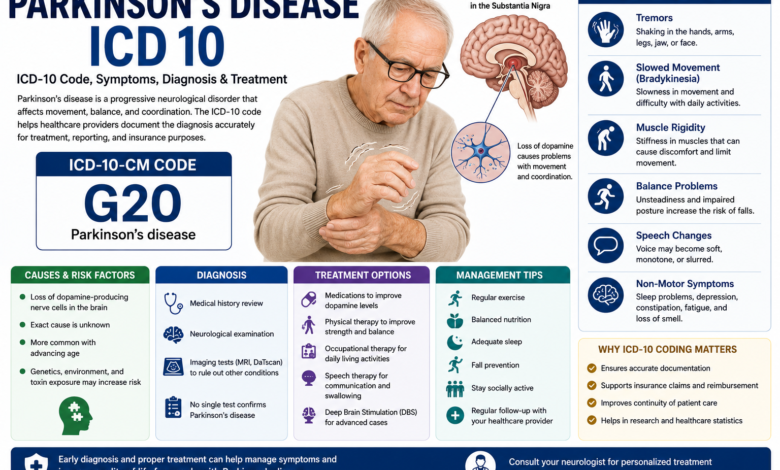
Parkinson’s disease icd 10 is a progressive neurological disorder that affects movement, balance, coordination, and muscle control. It develops gradually as nerve cells in the brain responsible for producing dopamine become damaged or die. Although there is currently no cure, early diagnosis and appropriate treatment can help manage symptoms and improve quality of life.
In medical documentation and healthcare billing, standardized diagnosis codes are essential for accurately recording diseases and communicating between healthcare providers, insurers, and health systems. One of the most commonly searched terms is “Parkinson’s disease ICD 10,” referring to the International Classification of Diseases, 10th Revision, Clinical Modification (ICD-10-CM) code used to identify Parkinson’s disease.
This guide explains the ICD-10 code for Parkinson’s disease, its purpose, symptoms, diagnosis, treatment options, and frequently asked questions.
What Is ICD-10?
The International Classification of Diseases, Tenth Revision (ICD-10) is a globally recognized system used to classify diseases, medical conditions, injuries, and health-related problems.
Healthcare professionals use ICD-10 codes to:
- Document medical diagnoses
- Support insurance claims
- Maintain electronic health records
- Track disease statistics
- Improve healthcare reporting
- Facilitate medical research
Each diagnosis is assigned a unique alphanumeric code.
Parkinson’s Disease ICD-10 Code
The primary ICD-10-CM code for Parkinson’s disease is:
G20 – Parkinson’s disease
This code is generally used when documenting a confirmed diagnosis of Parkinson’s disease in medical records and insurance claims.
Healthcare providers may also assign additional ICD-10 codes to document complications or symptoms associated with the condition, such as dementia, swallowing difficulties, or gait abnormalities, when applicable.
What Is Parkinson’s Disease?
arkinson’s disease icd 10 is a chronic neurodegenerative disorder that primarily affects movement.
It occurs when dopamine-producing nerve cells in a part of the brain called the substantia nigra gradually deteriorate. Reduced dopamine levels interfere with the brain’s ability to coordinate smooth, controlled muscle movements.
The condition usually develops slowly and progresses over many years.
Common Symptoms of Parkinson’s Disease
Symptoms vary from person to person but commonly include:
Tremors
A resting tremor often begins in one hand or fingers before gradually affecting other parts of the body.
Slowed Movement (Bradykinesia)
Simple daily tasks may become increasingly difficult due to slower movements.
People may notice:
- Shorter steps
- Difficulty standing up
- Reduced facial expressions
- Slower walking
Muscle Rigidity
Muscles may become stiff, limiting flexibility and causing discomfort.
Rigidity commonly affects:
- Arms
- Legs
- Neck
- Shoulders
Balance Problems
As Parkinson’s disease progresses, balance and coordination may become impaired, increasing the risk of falls.
Changes in Handwriting
Many individuals develop unusually small handwriting, known as micrographia.
Speech Changes
Speech may become:
- Softer
- Monotone
- Slurred
- Hesitant
Non-Motor Symptoms
Parkinson’s disease can also affect many non-movement functions, including:
- Sleep disturbances
- Constipation
- Depression
- Anxiety
- Reduced sense of smell
- Fatigue
- Cognitive changes
Causes of Parkinson’s Disease
The exact cause remains unknown.
Researchers believe the condition results from a combination of:
- Genetic factors
- Environmental exposures
- Aging-related brain changes
Most cases develop after age 60, although younger adults may also be affected.
Risk Factors
Several factors increase the likelihood of developing Parkinson’s disease.
These include:
- Older age
- Male sex
- Family history
- Certain environmental toxin exposures
- Specific genetic mutations
Having one or more risk factors does not necessarily mean a person will develop Parkinson’s disease.
How Parkinson’s Disease Is Diagnosed
There is no single laboratory test that confirms Parkinson’s disease.
Healthcare providers typically use:
Medical History
Questions focus on:
- Symptoms
- Medication use
- Family history
- Symptom progression
Neurological Examination
The examination evaluates:
- Tremor
- Muscle tone
- Walking
- Coordination
- Balance
- Reflexes
Imaging Tests
Brain imaging such as MRI may be performed to exclude other neurological conditions.
Specialized imaging may occasionally assist in difficult cases.
Treatment Options
Although Parkinson’s disease cannot currently be cured, treatment helps control symptoms.
Medications
Common medications aim to increase dopamine activity or improve communication between brain cells.
Medication plans vary depending on the individual’s symptoms.
Physical Therapy
Exercise programs improve:
- Balance
- Strength
- Flexibility
- Walking ability
Occupational Therapy
Occupational therapists help individuals maintain independence during daily activities.
Speech Therapy
Speech-language therapy addresses:
- Voice changes
- Swallowing difficulties
- Communication problems
Deep Brain Stimulation (DBS)
Some patients with advanced Parkinson’s disease may benefit from deep brain stimulation.
This surgical procedure uses implanted electrodes to help manage movement symptoms in carefully selected individuals.
Living with Parkinson’s Disease
Healthy lifestyle habits may improve overall well-being.
Helpful strategies include:
- Regular exercise
- Balanced nutrition
- Adequate sleep
- Fall prevention
- Social engagement
- Routine medical follow-up
Many people continue leading active lives for many years after diagnosis.
Why ICD-10 Coding Matters
Accurate ICD-10 coding supports:
- Proper medical documentation
- Insurance reimbursement
- Continuity of care
- Healthcare quality improvement
- Public health reporting
- Medical research
Using the correct diagnosis code ensures healthcare records remain consistent and accurate.
Frequently Asked Questions
What is the ICD-10 code for Parkinson’s disease?
The standard ICD-10-CM diagnosis code is G20 for Parkinson’s disease.
Can Parkinson’s disease be cured?
Currently, there is no cure, but treatments can effectively manage symptoms and improve quality of life.
Is Parkinson’s disease hereditary?
Most cases are not directly inherited, although genetics may contribute to disease risk in some individuals.
Can exercise help?
Yes. Regular physical activity can improve balance, mobility, flexibility, and overall physical function.
Conclusion
Parkinson’s disease ICD 10 coding plays an essential role in modern healthcare by ensuring accurate diagnosis documentation, insurance processing, and continuity of patient care. The parkinson’s disease icd 10 code for Parkinson’s disease is G20, which healthcare professionals use to identify the condition in medical records.
While Parkinson’s disease is a lifelong neurological disorder, early diagnosis, appropriate medications, rehabilitation therapies, regular exercise, and ongoing medical care can significantly improve quality of life and help individuals maintain independence for as long as possible.