Define Deliriously: Meaning, Examples & Everyday Uses

Language is full of words that add emotion, depth, and vivid description to everyday conversations. One such word is “define deliriously.” Although it is commonly used in books, movies, news articles, and casual speech, many people are unsure of its exact meaning or how to use it correctly.
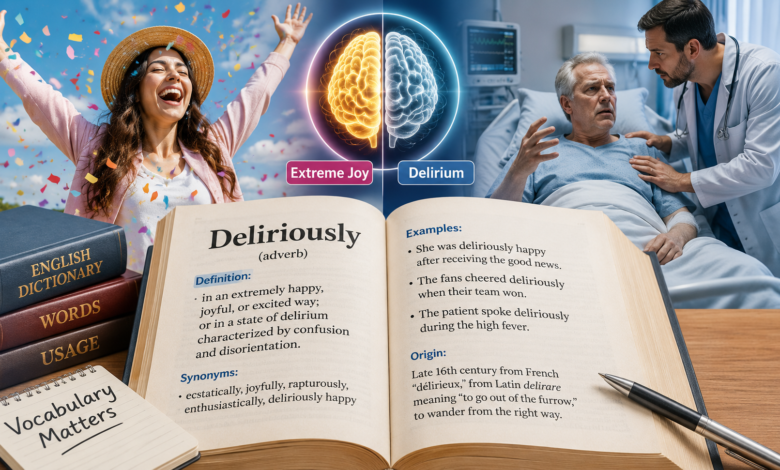
The word deliriously can describe someone extremely happy, excited, or joyful. In medical situations, however, it may refer to a person experiencing delirium, a serious condition that causes confusion, disorientation, and changes in awareness. Because the word has both figurative and medical meanings, understanding the context is essential.
Whether you’ve seen phrases like “deliriously happy,” “deliriously in love,” or “speaking deliriously,” knowing what the word means can improve both your vocabulary and your understanding of written and spoken English.
This guide explains the meaning of deliriously, its origins, common uses, examples, synonyms, and the difference between its everyday and medical meanings.
Define Deliriously
Deliriously is an adverb that describes doing something in a state of intense emotion or mental confusion.
Depending on the context, it can mean:
- Extremely happy or joyful
- Wildly excited
- Overwhelmed with emotion
- Acting irrationally because of excitement
- Speaking or behaving in a confused state due to illness or delirium
The surrounding words usually make its intended meaning clear.
What Does Deliriously Mean?
In everyday English, deliriously most often means extremely or overwhelmingly happy.
For example:
- She was deliriously happy after receiving the job offer.
- The fans were deliriously excited when their team won the championship.
- They were deliriously in love and couldn’t stop smiling.
In these examples, the word emphasizes an unusually high level of happiness or excitement.
In medical contexts, however, the meaning changes.
For example:
- The patient spoke deliriously during the high fever.
- He became deliriously confused after the infection spread.
Here, the word describes behavior caused by delirium, a serious condition affecting the brain.
Origin of the Word
The word deliriously comes from the adjective delirious, which traces its roots to the Latin word delirare, meaning “to go out of the furrow” or “to go off track.”
Over time, the meaning evolved to describe someone whose thoughts or actions had moved away from normal reasoning.
Today, English uses delirious in both literal and figurative ways:
- Medical confusion
- Extreme excitement
- Overwhelming happiness
Adding -ly changes the adjective into the adverb deliriously, describing how an action is performed.
Everyday Meaning of Deliriously
Most people encounter the word in everyday conversation rather than in medical settings.
In daily language, deliriously usually expresses powerful positive emotions.
Examples include:
Deliriously Happy
This means someone is happier than usual.
Example:
After hearing the good news, she was deliriously happy for the rest of the day.
Deliriously Excited
This describes intense excitement.
Example:
The children were deliriously excited on the morning of their vacation.
Deliriously in Love
This phrase describes people who feel deep romantic happiness.
Example:
The newly married couple appeared deliriously in love.
Deliriously Funny
Sometimes the word describes something so amusing that people laugh uncontrollably.
Example:
The comedy show was deliriously funny from beginning to end.
Medical Meaning of Deliriously
In healthcare settings, deliriously has a very different meaning.
It refers to behavior caused by delirium, a medical condition involving sudden confusion and changes in mental awareness.
Someone who is behaving deliriously may:
- Speak incoherently
- Become confused
- Have difficulty recognizing people
- Experience hallucinations
- Appear restless or agitated
- Have trouble focusing
Delirium often develops suddenly and requires prompt medical evaluation because it may be caused by an underlying illness or medical emergency.
Common Situations Where the Word Is Used
The meaning of deliriously depends entirely on the situation.
Here are some common examples.
In Everyday Conversation
People often use the word to describe intense emotions.
Examples:
- We were deliriously happy after our baby was born.
- She smiled deliriously when she saw the surprise gift.
- Everyone became deliriously excited during the concert.
In Literature
Authors frequently use deliriously to create vivid emotional descriptions.
Examples include characters who are:
- Deliriously joyful
- Deliriously frightened
- Deliriously hopeful
- Deliriously in love
The word helps readers imagine emotions that go beyond ordinary feelings.
In News and Media
Journalists may use deliriously to describe public reactions.
For example:
- Fans celebrated deliriously after the championship victory.
- Supporters cheered deliriously following the announcement.
Here, the word highlights overwhelming excitement rather than medical confusion.
In Medical Reports
Healthcare professionals use the term differently.
Example:
The patient became deliriously confused following surgery.
In this situation, the word indicates a serious change in mental status that requires medical attention.
Examples of Deliriously in Sentences
Seeing the word used in different contexts makes its meaning easier to understand.
Examples include:
- She laughed deliriously after hearing the unexpected news.
- The audience applauded deliriously throughout the performance.
- He looked deliriously happy after graduating from college.
- The child became deliriously excited before opening birthday presents.
- During the illness, the patient spoke deliriously throughout the night.
- The fans celebrated deliriously after their team’s dramatic victory.
- They danced deliriously as the music played.
Each example uses the same word but in slightly different emotional or medical contexts.
Why Context Matters
The word deliriously can have both a positive and a serious meaning.
Consider these two sentences:
- She was deliriously happy after winning the award.
- The patient was speaking deliriously because of a high fever.
Although the same adverb appears in both examples, the meanings are entirely different because of the surrounding words.
Understanding context prevents misunderstandings and helps readers interpret the intended message correctly.
Synonyms of Deliriously
Using synonyms can help expand your vocabulary and make your writing more engaging. The best synonym depends on how the word is being used.
When deliriously means extremely happy or excited, similar words include:
- Ecstatically
- Joyfully
- Blissfully
- Exuberantly
- Enthusiastically
- Excitedly
- Elatedly
- Gleefully
- Rapturously
- Euphorically
Example
Original: She smiled deliriously after hearing the good news.
Alternative: She smiled ecstatically after hearing the good news.
Both sentences express overwhelming happiness.
Antonyms of Deliriously
Antonyms are words with opposite meanings.
When referring to extreme happiness, possible antonyms include:
- Sadly
- Calmly
- Miserably
- Unhappily
- Gloomily
- Solemnly
- Indifferently
- Quietly
For example:
- Instead of celebrating deliriously, the team left the field quietly after the loss.
Deliriously vs. Delirious
These two words are closely related but serve different grammatical purposes.
Delirious (Adjective)
Delirious describes a person, place, or thing.
Examples:
- The patient became delirious after developing a high fever.
- She was delirious with excitement after winning the competition.
Deliriously (Adverb)
Deliriously describes how someone behaves or performs an action.
Examples:
- The patient spoke deliriously during the night.
- The crowd cheered deliriously after the final goal.
Remember this simple rule:
- Delirious = describes a noun.
- Deliriously = describes a verb, adjective, or another adverb.
Common Mistakes When Using “Deliriously”
Because the word has both figurative and medical meanings, people sometimes misuse it.
Mistake 1: Assuming It Always Means Illness
Many people think deliriously only refers to confusion caused by illness.
In reality, it often describes extreme happiness or excitement.
Correct example:
- She was deliriously happy after getting engaged.
Mistake 2: Using It for Mild Emotions
The word suggests a very strong emotional state.
Instead of saying:
- He was deliriously pleased with his lunch.
A more natural sentence would be:
- He was very pleased with his lunch.
Mistake 3: Confusing It With “Deliberately”
Although they sound somewhat similar, they have completely different meanings.
- Deliriously relates to intense emotion or confusion.
- Deliberately means intentionally or on purpose.
Tips for Using the Word Correctly
To use deliriously naturally, remember these tips:
- Use it to emphasize very strong emotions.
- Consider the context before choosing the word.
- Avoid overusing it in everyday writing.
- Reserve it for situations involving intense excitement, joy, or genuine delirium.
- Read example sentences to understand how native speakers use it.
Frequently Asked Questions (FAQs)
What does “deliriously” mean?
Deliriously means acting or feeling with extreme excitement, happiness, or emotion. In medical settings, it can also describe confused behavior caused by delirium.
Is “deliriously happy” a positive phrase?
Yes. Deliriously happy means someone is extremely joyful or excited. It is a common expression in everyday English.
Can “deliriously” have a medical meaning?
Yes. Healthcare professionals use the word to describe behavior associated with delirium, a serious condition involving sudden confusion and changes in awareness.
What is the difference between “delirious” and “deliriously”?
Delirious is an adjective that describes a person or condition, while deliriously is an adverb that describes how an action is performed.
Is “deliriously” commonly used?
Yes. The word frequently appears in books, newspapers, movies, and everyday conversation, especially in phrases like deliriously happy or deliriously in love.
What is a simple definition of “deliriously”?
A simple definition is “in an extremely excited, joyful, or confused manner, depending on the context.”
Conclusion
The word deliriously is a versatile English adverb that can express overwhelming happiness, excitement, or emotional intensity. In everyday conversations, it most often appears in phrases such as deliriously happy, deliriously excited, or deliriously in love, where it emphasizes powerful positive emotions.
In medical settings, however, the meaning changes significantly. Here, deliriously refers to behavior associated with delirium, a condition that causes sudden confusion and altered awareness. Understanding the context is essential because the same word can carry either a joyful or a serious meaning.
Learning how and when to use deliriously correctly can strengthen your vocabulary, improve your writing, and help you better understand books, articles, and conversations where the word appears.