When does implantation bleeding occur? This is a common question for people who are trying to conceive or wondering whether early spotting could be an early sign of pregnancy.
Implantation bleeding refers to light vaginal spotting that some people may experience around the time a fertilized egg attaches to the lining of the uterus. It is generally described as lighter than a normal menstrual period and may last a short time. However, not everyone experiences implantation bleeding, and spotting alone cannot confirm pregnancy.
The timing can also be confusing because implantation may occur close to when a menstrual period is expected. Other causes of vaginal bleeding, including the beginning of a period, hormonal changes, birth control, infections, or pregnancy-related complications, can produce similar symptoms.
This article explains when implantation bleeding may occur, what it can look like, how it differs from a period, when pregnancy testing may be useful, and when medical attention is important.
What Is Implantation Bleeding?
Implantation bleeding is light spotting that may occur around the time an embryo attaches to the uterine lining.
After fertilization, the developing embryo travels toward the uterus. Once it reaches the uterus, implantation occurs when it attaches to the endometrium, the lining of the uterus.
Small blood vessels in the uterine lining can sometimes be disturbed during this process, potentially causing a small amount of spotting.
Importantly, not everyone has implantation bleeding. Many people become pregnant without experiencing any noticeable bleeding or spotting.
When Does Implantation Bleeding Occur?
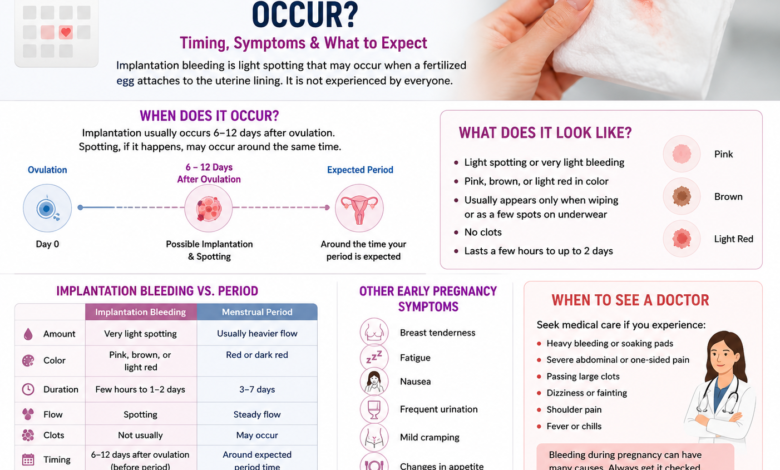
Implantation generally occurs about 6 to 12 days after ovulation, although the exact timing varies.
Because ovulation does not happen on exactly the same day for everyone, the timing of possible implantation spotting can vary from person to person.
For someone with a regular menstrual cycle, possible implantation spotting may occur several days before the expected period. However, spotting around this time does not necessarily mean implantation has occurred.
The timing can be affected by:
- The day ovulation occurred
- The timing of fertilization
- Individual menstrual-cycle length
- Natural variation in implantation timing
For this reason, it is usually not possible to determine pregnancy solely from the day spotting occurs.
Can Implantation Bleeding Occur Before a Missed Period?
Yes. If implantation-related spotting occurs, it may happen before the expected menstrual period.
This is one reason people sometimes mistake it for an unusually light period.
However, bleeding before an expected period can have many causes. Spotting should therefore not be considered proof of implantation or pregnancy.
A pregnancy test is a more reliable way to determine whether pregnancy has occurred.
What Does Implantation Bleeding Look Like?
When implantation spotting occurs, it is generally described as very light bleeding or spotting rather than a heavy menstrual flow.
It may appear:
- Light pink
- Brown
- Light red
- As a few spots on underwear
- Only when wiping
The amount is usually small.
Some people may notice only a small amount of discharge mixed with blood, while others may not notice any bleeding at all.
How Long Does Implantation Bleeding Last?
If implantation spotting occurs, it is generally short-lived.
It may last for several hours or up to a couple of days. It should not normally become progressively heavier like a typical menstrual period.
Persistent, heavy, or worsening bleeding should not automatically be attributed to implantation and should be evaluated by a healthcare professional.
Implantation Bleeding vs. Period
One of the most common questions is how to tell implantation bleeding apart from a menstrual period.
There is no completely reliable way to distinguish them based only on appearance, but some general differences may help.
| Feature | Possible Implantation Spotting | Menstrual Period |
|---|---|---|
| Amount | Usually very light | Usually heavier |
| Color | Pink, brown, or light red | Often red or dark red |
| Duration | Often brief | Commonly several days |
| Flow | Spotting | Continuous menstrual flow |
| Clots | Generally not expected | May occur during some periods |
| Timing | Around implantation after ovulation | Around the expected period |
These are general patterns rather than diagnostic rules. A light period can resemble spotting, and early pregnancy bleeding can vary.
Can Implantation Bleeding Be Heavy?
Implantation bleeding is generally described as light spotting.
Heavy bleeding is not typical of implantation.
If you are soaking through pads, passing large clots, experiencing significant pain, or feeling faint or weak, seek medical evaluation rather than assuming the bleeding is implantation bleeding.
Bleeding during pregnancy can have several causes, some of which require prompt medical attention.
Does Implantation Bleeding Mean You Are Pregnant?
Not necessarily.
Some people experience spotting around the time implantation could occur, but spotting by itself does not confirm pregnancy.
Pregnancy can be confirmed more reliably with a pregnancy test that detects human chorionic gonadotropin (hCG).
hCG begins to rise after implantation, but testing too early may produce a negative result even when pregnancy has occurred.
When Should You Take a Pregnancy Test?
For the most reliable result, follow the instructions on the pregnancy test you are using and consider testing around the time your period is expected or after a missed period.
Testing too early can make it harder to detect pregnancy because hCG may not yet be high enough to produce a positive result.
If a test is negative but your period does not arrive, repeating the test after a few days may be appropriate.
If you continue to have questions about pregnancy testing or irregular bleeding, speak with a healthcare professional.
Early Pregnancy Symptoms
Spotting is not the only possible early pregnancy symptom.
Some people may experience:
- Missed period
- Breast tenderness
- Fatigue
- Nausea
- Increased urination
- Mild abdominal cramping
- Changes in appetite
- Increased sensitivity to certain smells
However, many of these symptoms can also occur before a menstrual period. Symptoms alone cannot confirm pregnancy.
Can Implantation Bleeding Cause Cramping?
Some people report mild cramping around the time of possible implantation.
If cramping occurs, it may feel like:
- Mild lower abdominal discomfort
- A pulling sensation
- Light menstrual-like cramps
Severe, persistent, or one-sided abdominal pain is not something to assume is normal implantation discomfort and should be medically evaluated.
Other Causes of Early Spotting
Spotting around the time of a possible pregnancy can occur for reasons other than implantation.
Possible causes include:
Hormonal Changes
Changes in reproductive hormones can cause spotting at different points in the menstrual cycle.
Ovulation
Some people experience light spotting around ovulation.
Birth Control
Hormonal contraceptives, including birth control pills and certain devices, can sometimes cause irregular bleeding.
Cervical Irritation
The cervix may bleed slightly after sexual intercourse or certain medical examinations.
Infection
Some vaginal or sexually transmitted infections can cause unusual bleeding or discharge.
Pregnancy-Related Causes
Bleeding during pregnancy can also occur for several reasons. Some are harmless, while others require medical assessment.
When Is Bleeding During Early Pregnancy Concerning?
Any bleeding during a confirmed or suspected pregnancy can be worth discussing with a healthcare professional, particularly if it is more than light spotting.
Seek urgent medical care if bleeding occurs with:
- Severe abdominal or pelvic pain
- One-sided pain
- Shoulder pain
- Dizziness or fainting
- Heavy bleeding
- Passing large clots
- Significant weakness
- Fever
These symptoms can sometimes indicate a pregnancy complication, including an ectopic pregnancy or miscarriage, and should not be ignored.
Can You Have Implantation Bleeding With No Other Symptoms?
Yes.
Some people who become pregnant experience no noticeable early symptoms. Others may have symptoms such as fatigue, breast tenderness, or nausea.
The absence of spotting does not mean implantation did not occur, and the presence of spotting does not prove that implantation occurred.
Can You Have Implantation Bleeding After a Missed Period?
Implantation itself generally occurs before a missed period in a typical cycle, although cycle timing varies.
Bleeding that begins after a missed period should not automatically be labeled implantation bleeding. Other explanations should be considered, especially if pregnancy has already been confirmed.
Frequently Asked Questions
How many days after ovulation does implantation occur?
Implantation commonly occurs around 6 to 12 days after ovulation. Timing varies between individuals.
Is implantation bleeding always pink?
No. If spotting occurs, it may appear pink, brown, or light red. Color alone cannot determine its cause.
Is implantation bleeding heavy like a period?
Usually not. Implantation spotting is generally light. Heavy bleeding should be evaluated rather than assumed to be implantation bleeding.
Can implantation bleeding have clots?
Clots are not considered typical of light implantation spotting. Passing clots, especially with heavy bleeding or pain, warrants medical advice.
Can you have implantation bleeding without cramps?
Yes. Some people may experience spotting without cramping, while others may have mild cramps. Many people have no implantation symptoms at all.
Does implantation bleeding happen to everyone?
No. Many pregnant people do not experience implantation bleeding.
Can a pregnancy test be negative during implantation?
Yes. Testing very early may produce a negative result because hCG levels may not yet be high enough for the test to detect.
What is the best way to confirm pregnancy?
A properly used pregnancy test is a reliable way to check for pregnancy. A healthcare professional can provide further testing and evaluation when necessary.
Conclusion
So, when does implantation bleeding occur? If implantation spotting occurs, it may happen around 6 to 12 days after ovulation, often close to the time when a menstrual period is expected. It is generally described as light spotting that may be pink, brown, or light red and usually lasts a short time.
However, implantation bleeding does not happen to everyone, and spotting cannot confirm pregnancy. Menstrual bleeding, hormonal changes, birth control, infections, and other conditions can cause similar symptoms.
If you think you may be pregnant, a pregnancy test is a more reliable way to check. If bleeding is heavy, persistent, or accompanied by severe pain, dizziness, fainting, or other concerning symptoms, seek medical attention promptly.
Meta Title
When Does Implantation Bleeding Occur? Timing & Symptoms
Meta Description
Learn when implantation bleeding may occur, what it looks like, how long it lasts, and how to distinguish it from a period.